If you are trying to grow a business against larger competitors, it can feel like everyone else has more of everything.
More budget. More people. More content. More backlinks. More attention. More chances to show up before the customer ever finds you.
But bigger competitors also create more openings than they realize.
Every pricing change, review complaint, positioning shift, help doc, comparison page, and frustrated forum post can tell you where customers are not being served well. You do not need to outspend a larger company to use that. You need a reliable way to notice the right signals and turn them into action before they become obvious to everyone else.
That is the leverage small teams can actually use.
Bigger competitors leave openings you can use
A larger company creates a lot of public evidence about where it is going and who it is leaving behind.
When pricing moves up, some customers start looking for a simpler or cheaper option. When the homepage shifts toward enterprise teams, smaller buyers may feel ignored. When reviews repeat the same frustration, there is probably a problem the market already understands. When people search for workarounds, they are telling you what they wish the product made easier.
Those signals are not hidden. They are just scattered.
The advantage comes from connecting them while they are still small. One complaint might not mean much. The same complaint showing up in reviews, Reddit threads, search suggestions, and support discussions is different. That is a customer opening.
Find the customer pain they are too slow to fix
Big companies often optimize for the broad market. Their messaging has to work for multiple audiences. Their roadmap moves through priorities and approvals. Their content strategy tends to chase large, obvious keywords.
A smaller business can be more direct.
You can find a specific customer frustration and speak to it before anyone else does. You can write the page that answers the exact question a frustrated buyer is already searching. You can position around the segment that feels pushed aside. You can explain the migration path, the workaround, the simpler setup, or the pricing alternative in words that feel like they were written for one person.
That is where small teams can win. Not by being louder, but by being more relevant.
A customer searching for a broad category may still be browsing. A customer searching for an alternative, a fix, a migration path, or a way around a painful limitation is much closer to making a decision.
Turn those signals into one move you can make this week
The goal is not to collect competitor facts. The goal is to decide what to do next.
If a competitor is getting expensive for small teams, your move might be a landing page about simpler pricing. If customers complain that setup takes too long, your move might be a guide that shows the faster path. If people keep searching for a workaround, your move might be the article, template, or tool that solves it. If a competitor is moving upmarket, your move might be to speak directly to the customers they are leaving behind.
A useful market scan should give you a clear next step, not a pile of notes.
Something like:
Competitor A appears to be moving upmarket. Their pricing now emphasizes annual contracts, and recent reviews mention that smaller customers feel squeezed. The opening is a page for small teams that want simpler pricing and faster setup.
That is enough to know where the opportunity is. The next step is turning it into something customers can actually find.
Let Aera find the openings for you
This is where Aera comes in.
Aera is an AI browser that can research across real websites and turn what it finds into a usable answer. For this kind of growth work, that means you can give it the competitors you care about and ask it to find customer openings: pricing friction, repeated complaints, underserved segments, workaround searches, comparison pages, and recent product moves.
The important part is that it does not have to stop at research.
If the opening is pricing frustration, Aera can help draft the switching page. If it is setup pain, it can turn the research into a simpler guide. If it is a workaround search, it can help outline the page that answers that exact search. If it is an underserved segment, it can help rewrite the part of your homepage that needs to speak to that customer more clearly.
You still choose the strategy. Aera helps carry more of the work from signal to draft, so the opportunity does not die in a notes document.
Give it a mission tied to the outcome you want:
I run a small business in [market] and compete with [competitors]. Find openings where a smaller company could win customers. Look for pricing changes, positioning shifts, customer complaints, underserved segments, workaround searches, comparison pages, and recent product moves. Return the strongest opportunities with source links and the action I should take next.
That is enough to start. Aera is not just looking around. It is looking for the places where your business may be able to win.
Start with the competitor customers already compare you against
Pick one competitor this week. Choose the one that comes up most often in sales calls, customer conversations, search results, or your own anxiety.
Ask Aera to simply find one opening you can act on.
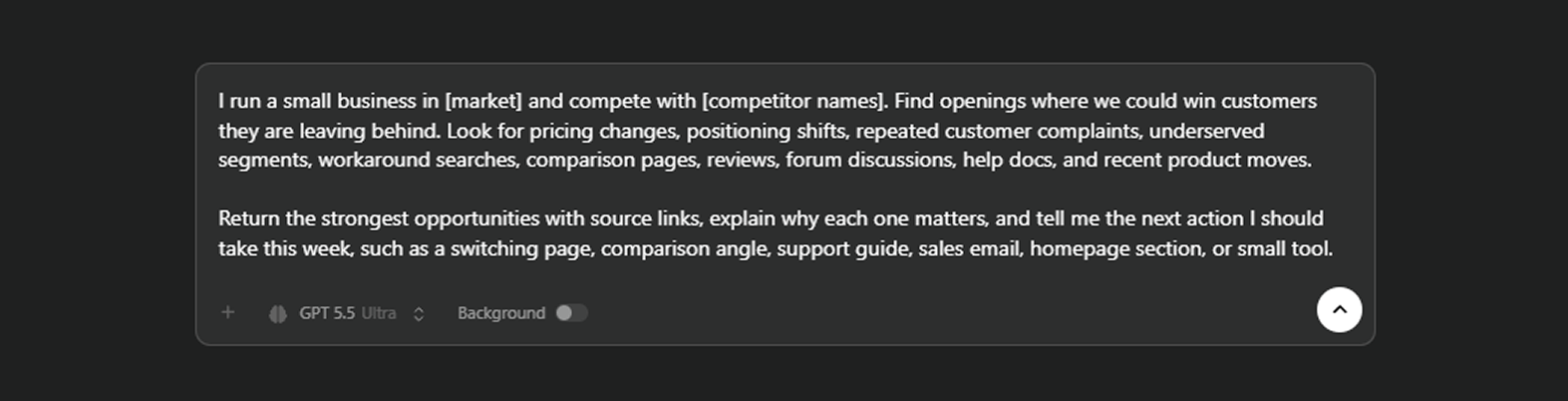
Once you've found that opening, ask Aera to help turn it into the first draft of the next thing you need: the switching page, the comparison angle, the support guide, the sales email, the homepage section, or the outline for a small tool. You can edit from there, but you are no longer starting from a blank page.
Then set Aera to run the same scan every week.
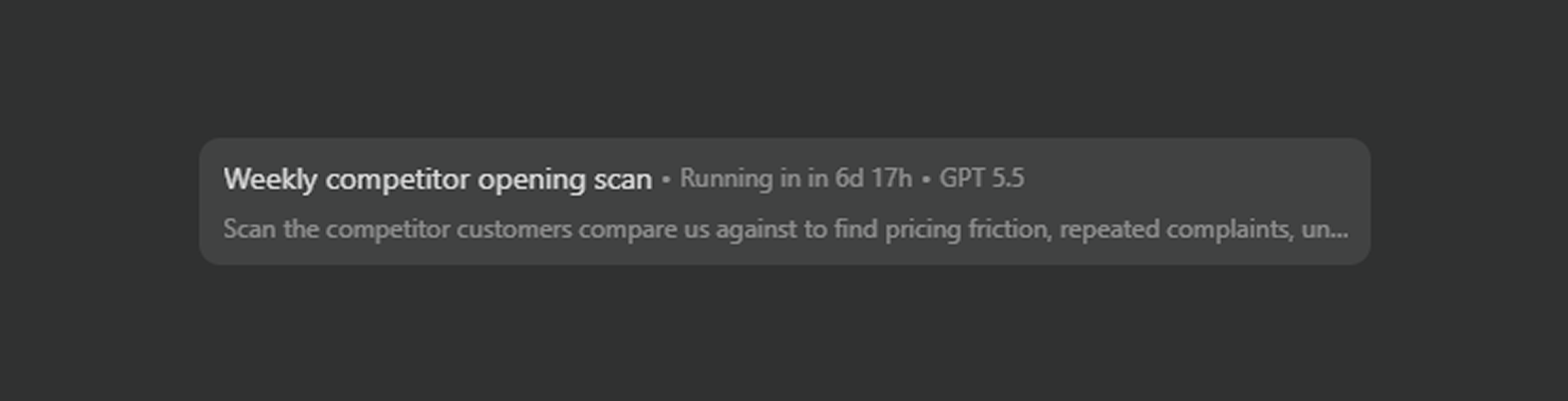
That is where the leverage compounds. One competitor, one signal, one move, repeated often enough that you keep noticing customer pain while it is still fresh.
Keep finding the customers they leave behind
You are not trying to copy bigger competitors. You are trying to see the parts of the market they are moving too slowly to serve.
Bigger companies will keep buying attention. You can win by finding the neglected moments: the pricing frustration, the workaround search, the underserved segment, the messy migration, the complaint that keeps repeating.
Find one of those moments, answer it better than anyone else, and you have a real path to customers that does not depend on outspending the market.
If that is the kind of leverage you want, Aera can do all of that for you, and then keep doing it in the background, on repeat, every single hour, day, or week.